


THE GREAT MERGE: Artist + AI = The Birth of the Prompt Artist
- Jorge A. Perez
- Mar 10
- 6 min read
One of the many great debates sparked by the recent rise of AI has swirled around fear, anger, worry, and honestly even disgust within parts of the artist community regarding the use of AI in art.
Is it really art?
Isn’t it just plagiarism?
In all honesty and from what we understand, early AI models were trained by being fed enormous amounts of information, visuals included, gathered from the internet. Much of that content came from things we’ve all unknowingly shared over the years on social media.
Yep… that fine print we probably should have read.
Regardless, this does not give corporations or developers the right to infringe on artists’ copyrights or ownership of their work. That conversation is important and ongoing.
But stepping back for a moment, we should also ask ourselves something bigger:
Isn’t it part of human evolution to experience growing pains when we stand on the cusp of a new technological leap forward?
Because history tells us we’ve been here before.
The conversation around AI art has sparked many debates, but it may also be giving rise to an entirely new kind of creator; what I call the Prompt Artist.
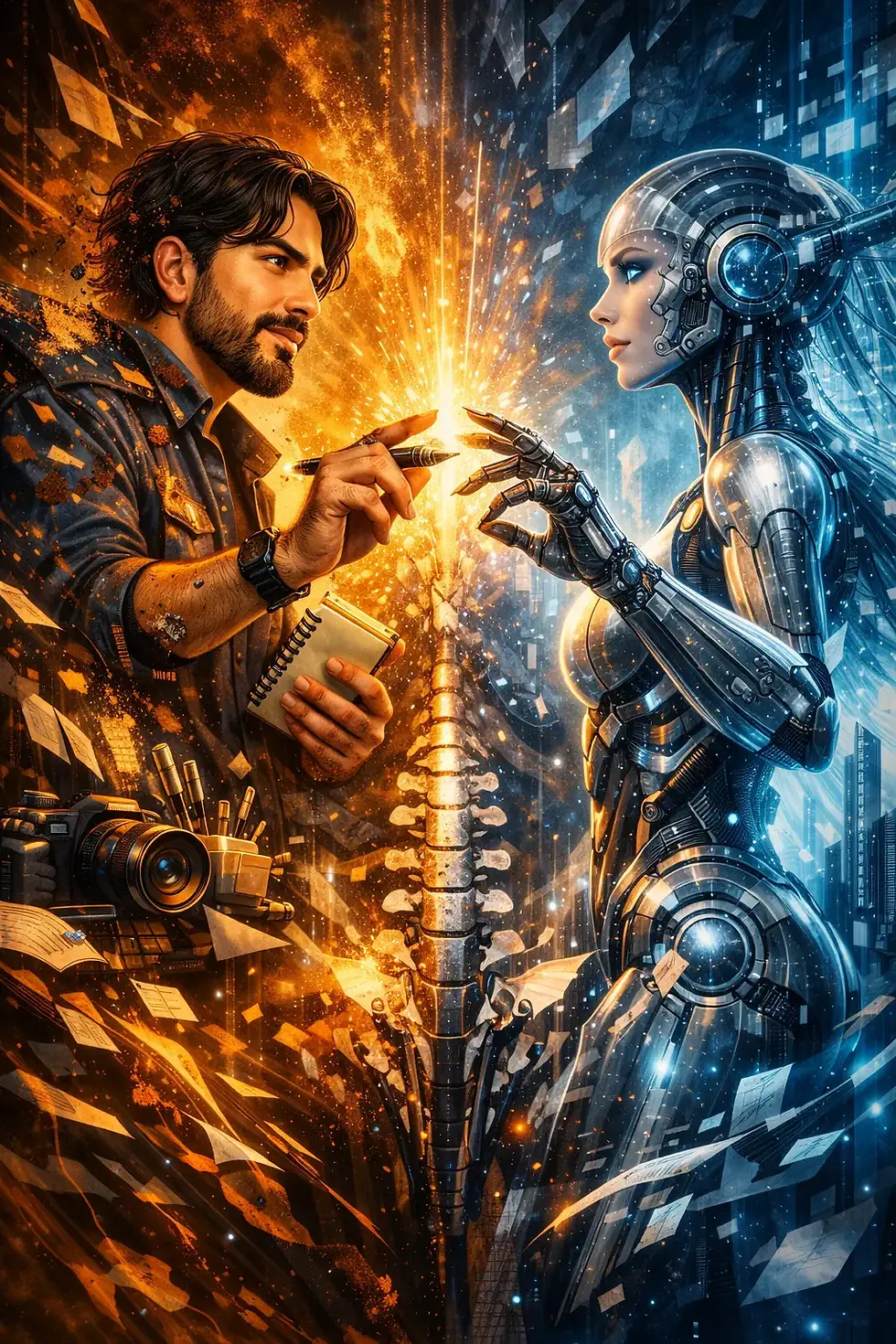
Art vs Technology: A Story As Old As Art Itself
If you look back throughout history, artists have repeatedly feared that new technology would diminish the value of their work.
Imagine the moment someone first asked:
“What if we could print copies of art?”
The earliest known dated printed book, the Chinese Buddhist Diamond Sutra was printed on May 11, 868 using woodblock printing. It is recognized as the earliest complete printed book with a precise publishing date.
That means we’ve been wrestling with this idea for over a thousand years.
Fast forward to 1835 when George Baxter introduced one of the first color printing processes, allowing artworks to be reproduced in color.
Once again, artists likely feared their craft would lose its value.
And yet… art survived.
More than that, art evolved.
The Rise of Digital Art: Another Moment of Fear
Let’s jump ahead closer to our own time.
When digital art began to rise, many traditional artists worried again that the beauty, craftsmanship, and the tactile magic of physical art would disappear.
But the opposite happened.
Digital tools expanded the creative world dramatically.
My personal favorite invention during that era?
Suddenly artists could experiment faster, iterate endlessly, and push the boundaries of imagination in ways that were previously impossible.
Instead of replacing traditional art, digital art created a new renaissance.
Artists began blending mediums.

Physical and digital worlds merged.
New generations of creators emerged.
And interestingly enough, traditional art became even more valuable.
Today many artists intentionally create paintings with such extreme precision that they resemble digital renderings. Hyper-realism has gone into overdrive, inspired partly by the possibilities digital artists introduced.
We Are Now Entering Another Renaissance
Which brings us to today.
We are once again standing on the edge of another artistic renaissance, one that merges physical art, digital art, and artificial intelligence.
As a mixed-media artist myself, I’ve always struggled with the question:
Should I focus on physical art, which I’ve always been naturally drawn to?
Or should I lean into the digital world that has fascinated me for years?
Over time I realized something important.
I didn’t have to choose.
Once I began combining both physical and digital processes, my work improved tenfold.
And then AI arrived.
My First Reaction to AI
Like many artists, my first reaction was panic.
“Oh no… this thing is going to replace us.”
“There will be no need for artists.”
“Art will lose meaning.”
“How do I protect my work?”
Sound familiar?
But then I stepped back and looked at AI the same way I’ve always looked at creative tools.
As an artist, we already rely on tools.
Different brushes create different strokes.
Some brushes are better for texture.
Others are better for color blending or fine details.

As a photographer, I’ve used Lightroom to enhance my images.
I’ve used Photoshop to create entire fantasy worlds without building expensive physical sets.
These tools never replaced my creativity.
They extended it.
The vision, the colors, the composition, the emotion; those still come from me.
AI, in many ways, is simply another tool.
A Practical Example
Let’s say I create a sketch by hand.
I refine it.
I scan it.
I turn it into a digital piece.
But what if I want a 3D version of that artwork?
Sure, I could spend years becoming a professional 3D artist. I could learn the entire technical skillset required to build a model from scratch.
But realistically, I may not have the time to dedicate years mastering that specific craft.
Instead, I can now become a master of prompting.
With the right prompts, I can guide AI to help generate a 3D interpretation of my original artwork, something incredibly close to the vision I had in my mind.
Is that not still art?
The Spiritual Nature of Creation
We live in a world that encourages people to be uniquely themselves, and I believe that is something worth protecting.
The act of creation has no fixed rules.
No map.
No single right way.
Creation, to me, feels like something that comes from beyond the self. Something that flows through us.
Call it inspiration.
Call it intuition.
Call it the collective unconscious.
Personally, I like to think of it as creativity flowing through the crown chakra, tapping into the Akashic records, that infinite library of ideas, experiences, and possibilities that exist beyond time.
It then pours through our imagination, our thoughts, our hands, our words.
That is the magic of art.
Fear of AI Is Familiar
Some artists today fear AI the way earlier artists feared printing presses or digital tools.
But imagine an artist 100 years from now looking back at 2026.
They might say:
“Those poor artists who thought AI would destroy the art world.”
History suggests the opposite will happen.
AI won’t destroy art.

It will expand it.
The Birth of a New Creative Identity: The Prompt Artist
What Is a Prompt Artist?
Before we go any further, it’s worth defining this new term clearly.
Prompt Artist (noun): A new type of creator who uses language to guide artificial intelligence in generating visual art, environments, characters, and concepts. Rather than painting or sculpting directly, a Prompt Artist directs AI through carefully crafted prompts, combining imagination, storytelling, and artistic vision to produce original creative work.
The rise of the Prompt Artist represents one of the most fascinating shifts happening in modern digital art and AI-assisted creativity. In many ways, Prompt Artists are becoming the storytellers and creative directors of the AI era, using words the way painters use brushes or sculptors use clay.
And this brings me to something I believe we are witnessing right now.
The birth of a new type of creator.
I call them:
The Prompt Artist: a new creative identity emerging at the intersection of imagination and artificial intelligence.
Prompt Artists are individuals with powerful imaginations who may not possess traditional drawing or painting skills, or perhaps simply lack the years required to master them.
What they do possess is something equally powerful:
The ability to direct AI through language.
Through prompts, they can shape visuals, worlds, characters, and stories that previously existed only in their minds.
Some critics argue that Prompt Artists aren’t “real artists” because AI performs the technical execution.
But I see it differently.
A novelist writes a script.
A film director interprets it.
A cinematographer brings it to life.
A composer adds emotion.
Art has always been collaborative.
Prompt Artists simply collaborate with AI.
In many ways, Prompt Artists are the story architects of the future.
Their medium is language.
Their collaborator is artificial intelligence.
And their canvas is limitless.
The Future of Art Is Expansion, Not Replacement
I genuinely look forward to seeing what the future holds for the art world in this new era.
And to my fellow traditional artists, don’t worry.
We’re not going anywhere.
If anything, our work may become even more valuable.
Because like fine wine, the rarer something becomes, the more people appreciate it.
The truth is that art has always evolved.
And one of the greatest joys of being an artist is watching your own creativity evolve with the world around you.
So instead of fearing the change…
Why not explore it?
After all, creativity has never been about standing still.
And perhaps the most exciting part of this moment is witnessing the emergence of entirely new creative identities, including the rise of the Prompt Artist in the age of artificial intelligence.

Comments